Targeted marketing gets discussed almost entirely in digital terms — Google Ads, Meta campaigns, email sequences, retargeting. But the principle is older than the internet: put the right message in front of the right person, rather than broadcasting at everyone and hoping. Print has always been capable of doing exactly that. The problem was never the channel — it was the lack of a way to measure it. That problem is now solved.
What Is Targeted Marketing?
Targeted marketing means deliberately narrowing who receives your message to people who match a defined profile — industry, location, job title, behaviour, or customer type — rather than reaching the widest possible audience regardless of fit. The goal is to spend marketing budget on people most likely to become customers, not on the full population who might theoretically be interested.
In digital marketing, targeting is handled algorithmically — you define parameters and a platform decides who sees your ad. In print marketing, targeting is manual and deliberate — you define who receives the piece, and it goes to those people and no one else. There is no algorithm involved, no bidding war for attention, and no competing content on the same surface. The piece lands in the right person's hands and stays there.
Why Print Is a Targeted Marketing Channel
The most targeted thing you can do in marketing is put a physical object in a specific person's hands. A brochure posted to a named decision maker at a pre-vetted company lands on their desk. It is not competing with 47 other pieces of content in a feed. It is not disappearing after three seconds of scroll time. It is a physical object that sits on a surface until someone picks it up, and when they do, it has their full attention.
For Irish businesses targeting a specific sector — accountancy firms, restaurants, solicitors, construction companies — a professionally designed brochure sent to a curated list is targeted marketing in its most direct form. The audience is defined before the campaign goes out. Every piece reaches a pre-qualified potential client. The response rate reflects genuine interest from the right people, not vanity metrics from a broad audience.
Door drop leaflet campaigns work on the same principle at a local level. A leaflet delivered to every household in a specific postcode targets geography precisely — a restaurant promoting a new menu to the immediate neighbourhood, a tradesperson advertising to the housing estates they serve, a salon reaching the local residential streets around their premises. The targeting is built into the distribution, not an algorithm.
The Measurement Problem — and How QR Codes Solved It
The reason print marketing fell out of favour with analytics-driven businesses was not effectiveness — it was accountability. Digital channels produce data automatically: impressions, clicks, conversions. Print produced responses only when someone called or walked in, with no clear way to attribute that action to a specific campaign.
A trackable QR code on a print piece closes that gap entirely. Every recipient who scans is recorded. The data shows how many people moved from print to digital, when they scanned, and — if the destination page is set up correctly — what they did when they got there. A brochure campaign sent to 500 businesses with a QR code linking to a dedicated landing page produces the same kind of measurable data as a Google Ads campaign: impressions delivered, scans as the equivalent of clicks, and landing page conversions as the outcome.
This changes the economics of targeted print marketing substantially. A campaign that previously produced enquiries with no clear attribution can now be tracked to a cost-per-scan and a cost-per-conversion — the same metrics used to evaluate any digital channel.
The Types of Print Used in Targeted Marketing Campaigns
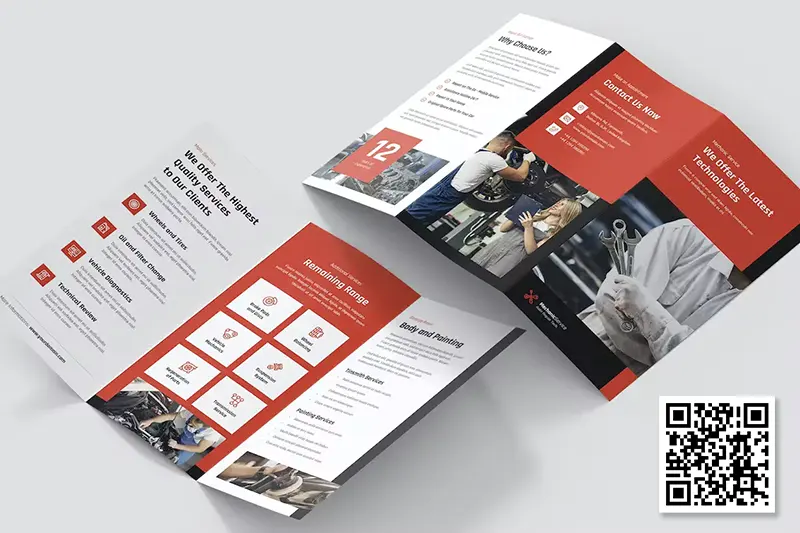
Brochures are the standard format for B2B targeted marketing in Ireland. A tri-fold A4 brochure sent to a curated list of businesses in a specific sector presents your services in full — more detail than a business card, more considered than a leaflet, more physical and lasting than an email. For professional services, construction, hospitality suppliers, and agencies, a brochure campaign targeting decision makers in a defined vertical is still one of the most effective routes to a qualified conversation.
Leaflets are the standard format for B2C targeted marketing at local level. A5 and A6 leaflets door-dropped to specific postcodes reach every household in a defined area. High volume, low unit cost, and geographically precise. For restaurants, takeaways, tradespeople, salons, and service businesses, a well-targeted leaflet drop in the right area generates responses that digital advertising in the same area often cannot match — because the physical piece lands in the home rather than competing in a feed.
Business cards with QR codes function as targeted marketing at the point of personal contact. A card handed to the right person after a meeting or a job well done is as targeted as marketing gets — one recipient, pre-qualified by the interaction that just happened, holding your contact details and a direct link to your website or review page. The design quality of that card determines what impression it makes in the moment it counts most.
Why Design Quality Is Not Optional in Targeted Marketing
In mass marketing, a mediocre creative gets averaged out across a large audience. In targeted marketing, where every recipient is a specific, pre-qualified potential client, the design quality of the print piece is doing more work per impression than almost any other format. There is no volume to compensate for a weak execution.
A brochure that arrives at a solicitor's desk, an accountant's office, or a restaurant owner's kitchen looking like it was produced in Canva and printed at home does not create the impression of a business worth hiring. A brochure that arrives looking professionally designed and produced — CMYK colours that match the brand, sharp typography, quality paper stock — creates a different first impression before a word is read. That impression is part of the targeting: it signals that the business sending it operates at a professional standard.
This is why the production standard of targeted print marketing matters as much as the list it is sent to. The right audience with poor design produces worse results than slightly broader targeting with excellent design. The piece is your representative in a room you are not in — it needs to make the right case without you.
When to Design and Distribute Yourself vs Use a Full Campaign Service
For businesses with an existing customer list, a local service area, or a defined geographic target, designing and distributing print yourself is straightforward. We design the piece, supply print-ready files or handle the print and delivery, and you distribute through your own channels — handing cards to customers, distributing leaflets locally, or using a letterbox service for door drops.
For businesses targeting a specific industry sector across a wider geography — accountants targeting SMEs in a specific county, an agency targeting hospitality businesses nationally, a supplier targeting a defined vertical — a managed campaign service that handles list sourcing, print production, and posting is more practical. District Zero's targeted marketing service handles this end to end for Irish B2B businesses: a targeted list of pre-vetted companies, professionally designed brochure, print production, and posting in a single managed campaign.
The design brief is the same in both cases. The difference is who manages the distribution.
Targeted Marketing and Seasonal Print
Seasonal campaigns are a specific form of targeted marketing where the targeting is temporal rather than demographic — you are reaching your existing audience or your local area at the moment when they are most likely to buy. A Christmas leaflet door-dropped to the households around a restaurant targets the right people at the right time. A Halloween poster in the window of a bar targets passing foot traffic during the period when themed events are being searched for.
The same principle applies: a well-produced seasonal print piece outperforms a generic one because it signals that the business has put thought into how it presents itself. For Christmas and Halloween campaigns in particular, the businesses that stand out are the ones whose print looks like it was designed for the purpose — not adapted from a generic template at the last minute.
Conclusion — Targeted Marketing Is Still About the Right Person Seeing the Right Thing
The principle of targeted marketing has not changed. The tools have. A business that combines a well-defined audience, professionally produced print, and a trackable QR code has a targeted marketing campaign that is measurable, accountable, and competitive with digital channels — at a fraction of the cost-per-impression of paid search in most Irish sectors.
The channel is not the variable that determines results. The quality of the creative and the precision of the targeting are. Both are worth getting right.
Get a Print Design Quote